Activities to Strengthen Your Child’s Imagination
“Imagination is the engine of creativity, innovation, and resilience.”
Imagination is the engine of creativity, innovation, and resilience. Yet in our structured, screen-filled world, many children have limited space to simply imagine and create. Parents can reclaim imagination as a central part of childhood by deliberately building time and space for imaginative play.
Why Imagination Matters for Child Development
Imaginative play helps children process emotions, develop empathy, and work through challenges in safe ways. When a child plays out a scenario, they are rehearsing social interactions and emotional responses. Imaginative thinking is essential for problem-solving, innovation, and adaptation in an unpredictable world. Children who engage regularly in imaginative play show better emotional regulation and greater resilience when facing difficulties.
The activities that strengthen imagination share a common feature: they are open-ended rather than prescriptive. There is no single correct answer or outcome.
Storytelling and Story Creation
Storytelling and story creation lie at the heart of imaginative development. Encourage your child to tell you stories, and listen without interruption. Ask follow-up questions that invite elaboration: ‘What happened next? How did that character feel?’ You might create stories together, taking turns adding sentences. Write down their stories and read them back. This validates imaginative work and shows your child that their ideas matter.
Dramatic Play and Building
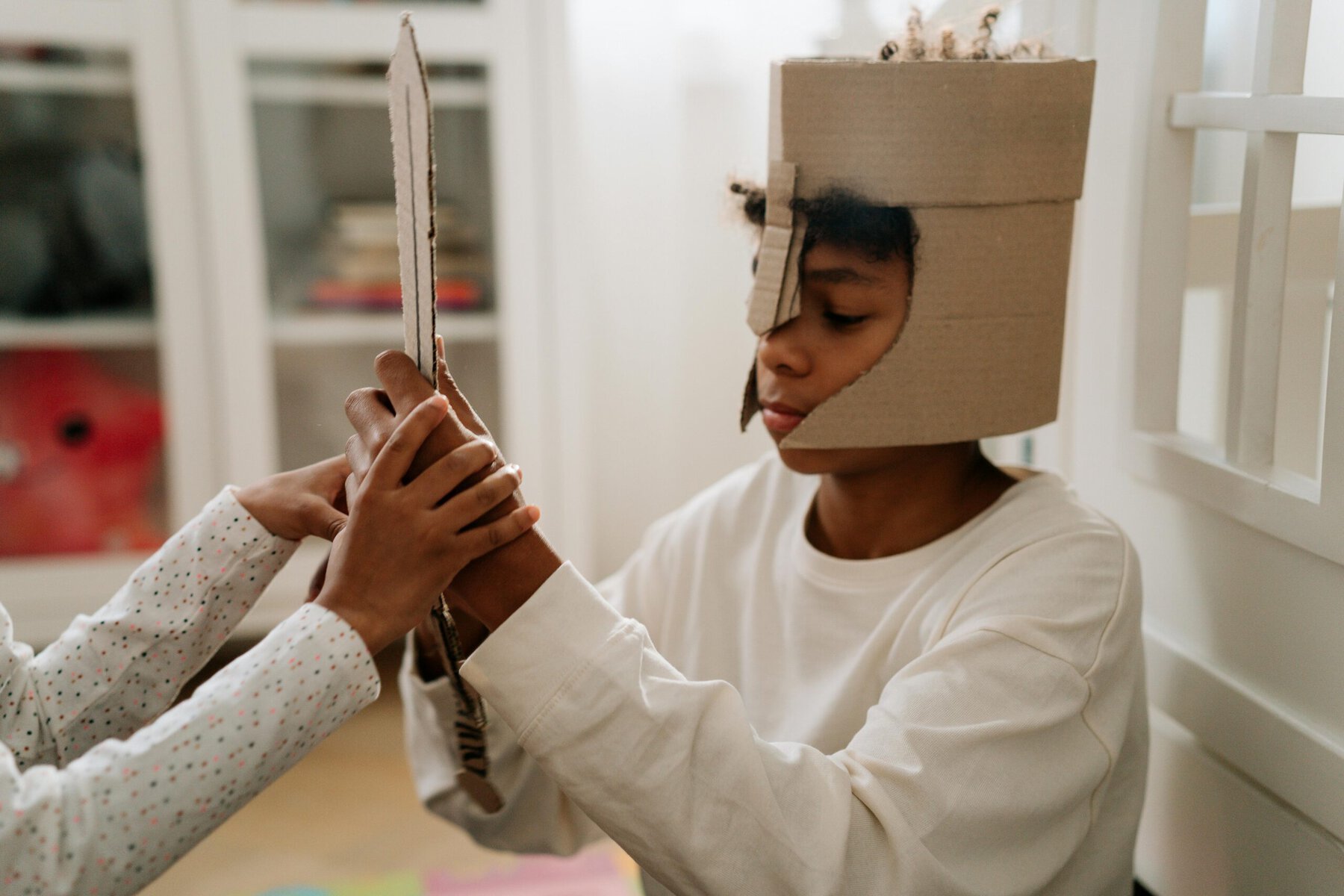
Dramatic play is extraordinarily powerful for children under twelve. Set up a simple dress-up corner with clothes, accessories, and props. Let your child create scenarios: a doctor’s surgery, a restaurant, a spaceship. Join in if invited, but follow their lead. Dramatic play allows children to explore different roles and perspectives safely.
Building and construction engage imaginative thinking differently. Provide open-ended materials: blocks, cardboard boxes, recycled containers, craft supplies. Rather than following instructions to build a specific structure, let your child decide what to create. What do they imagine? What does their construction become? When a structure is complete, ask them to tell you about it. You might help them create a sign or label.
Art and Creative Expression
Art activities that prioritise process over product build imaginative confidence. Rather than colouring-in sheets or specific craft projects, provide materials and let your child decide what to create. Mix paint colours and discover new shades. Collage with magazines and scrap materials. Sculpture with clay. The goal is exploration and self-expression, not creating something ‘good enough’ to display on the fridge (though if your child wants that, wonderful).
Nature-Based and Music Imaginative Play
Nature-based imaginative play is particularly rich. A woodland becomes an enchanted forest. A stream becomes a wild river to cross. Rocks become creatures, castles, or stepping stones. Branches become swords, magic wands, or building materials. Nature provides endless loose parts for imaginative construction and play.
Limiting screen time is essential. While some children’s programming can be educational, nothing replaces the active thinking required for imaginative play. A child watching a screen is a consumer of someone else’s imagination. A child engaged in play is the author of their own stories.
Music and movement also strengthen imagination. Let your child move however they wish to music, without teaching them steps. Encourage them to create musical compositions or songs. These activities build bodily creativity alongside mental flexibility.
Creativity at the Heart of Learning
Schools that place creativity at the heart of learning, like Longacre, understand that imaginative thinking is not a luxury add-on but foundational to genuine learning. When schools prioritise imagination alongside traditional academics, children develop confidence in their own creative thinking.
You can find out more at https://www.longacre.surrey.sch.uk/
The challenge for modern parents is reclaiming time and permission for unstructured, imaginative play. Every hour spent imagining, creating, and playing without adult direction is an investment in your child’s flexibility, resilience, and lifelong capacity for innovation. Your role is not to entertain your child constantly, but to create space where their own imagination can flourish.
About the Author: Longacre School is a forward-thinking independent school that places creativity and imagination at the centre of its educational philosophy. Longacre believes that imaginative thinking develops the whole child and prepares learners for a rapidly changing world.


